We trusted Telegram with our research to protect users — and were written out of the story
NTLM relay, repeatable heap-memory disclosure, a laboratory-validated RCE chain, and the documented Telegram and Qt remediation timeline.
Research conducted against Telegram Desktop 6.8.4 (Qt 6.11.1) in an isolated lab. Affected: proxy handling in Qt ≤ the versions fixed alongside Telegram Desktop 6.9.2. Reported to Telegram 2026-06-06; fixes shipped in Telegram Desktop 6.9.2 and corresponding Qt releases; CVE pending.
“Our experience is shaped by our mission to protect our users in authoritarian regimes.”
— Pavel Durov, September 5, 2024; original post.
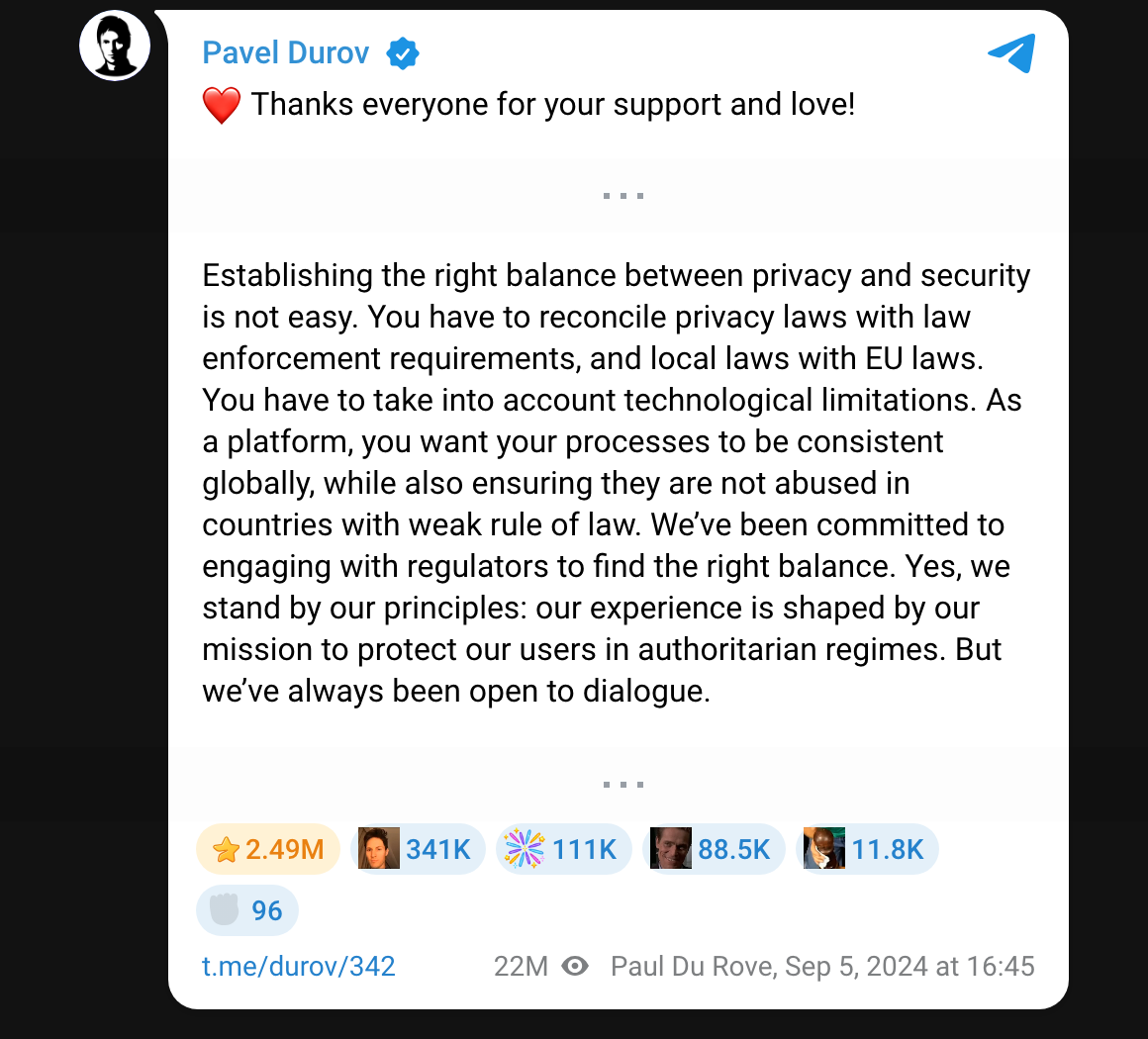
We agree with these words. More than that—we believed them.
For someone living under censorship, a Telegram proxy is more than a setting in an application. At times, it is the last narrow path to independent information and the open internet. But that path to freedom becomes a trap if it can silently disclose credentials, expose process memory, or give an attacker control of the device.
After discovering exactly such a risk, we could have reported it to Qt first, established a record of our discovery, and waited through the usual remediation cycle. We chose differently. The night before disclosure, we did not sleep: we revalidated the attack chain, assembled the technical evidence, and documented every stage so Telegram engineers could reproduce the issue immediately. On June 6, we sent Telegram a complete technical report, explicitly marked confidential and prohibited from distribution without permission from ExPatch LLC. Telegram controlled the application and could block the most dangerous path faster than anyone else. We therefore put user safety ahead of sleep, convenience, and the opportunity to establish priority with Qt first.
Telegram was given the first opportunity to protect its users—and used it. Soon afterward, corresponding fixes appeared in Qt, while we were neither informed of upstream coordination nor included in it, and neither the researchers nor ExPatch appeared in the public attribution. Was this routine upstream coordination, or a breach of the trust that gave Telegram its head start? This article presents the documents, code, and timeline so readers can decide for themselves.
The research was conducted against Telegram Desktop 6.8.4, which used Qt 6.11.1.
From Proxy Handling to NTLM
The investigation began with the architecture of Telegram Desktop’s proxy subsystem. We established that HTTP and SOCKS5 proxy connections are delegated to Qt. At this stage, our focus was not a particular library or company, but the trust boundary itself: what happens when a hostile proxy server controls responses during connection establishment? That question became the starting point for the audit.
For almost a month, we examined this mechanism from multiple angles: trust boundaries, state transitions, and ways to force the client into unexpected behavior. Most directions eventually reached a dead end, and the attack surface appeared nearly exhausted. The turning point came when we found that, during an active proxy exchange, Qt accepted a demand to switch authentication to NTLM. A modern proxy connection could silently transition to a legacy mechanism associated with NTLM Relay attacks for decades.
At a high level, the chain is remarkably simple. Telegram Desktop connects through a configured HTTP proxy and Qt sends a CONNECT request. A hostile proxy replies with 407 Proxy Authentication Required and advertises Proxy-Authenticate: NTLM. Qt treats the response as a normal authentication challenge, starts NTLM automatically, and sends the first handshake message—NTLM Type 1 (Negotiate). No explicit user consent is requested.
The key question was which checks Qt performed before allowing NTLM to use the user’s system credentials. Because NTLM Relay has been understood for decades, we expected a control that bound authentication to the intended proxy and prevented the same exchange from being replayed to another service. The implementation contained no such protection: Qt did not validate an expected SPN, did not bind the exchange to a protected channel through EPA, and did not require exchange integrity through MIC. An attacker controlling the proxy did not need to crack NTLM or recover a password; relaying the authentication messages to another service in real time was enough.
This finding changed the investigation completely. NTLM was not hidden behind an obsolete enterprise configuration—it could be triggered in the middle of an ordinary proxy exchange. After a victim connected to the attacker-controlled HTTP proxy, the attacker needed only one normal-looking response: 407 Proxy Authentication Required with Proxy-Authenticate: NTLM. A single header caused Qt to involve the user’s system credentials in an NTLM exchange automatically.
How Qt Starts NTLM Without Confirmation
To understand why one proxy response was sufficient, we traced the complete execution path from processing the 407 response to generating the authentication message. The path consists of three levels.
Level 1 — Qt Accepts the 407 Response
Telegram Desktop configures the proxy through QTcpSocket::setProxy. In qhttpsocketengine.cpp:562–599, Qt processes the proxy’s response to CONNECT. A 407 Proxy Authentication Required status is passed to the built-in authentication mechanism:
} else if (statusCode == 407) {                         // :562
    if (d->authenticator.isNull())
        d->authenticator.detach();

    priv = QAuthenticatorPrivate::getPrivate(
        d->authenticator
    );

    const auto headers = d->reply->header();

    priv->parseHttpResponse(
        headers,
        true,                                            // isProxy=true
        d->proxy.hostName()
    );                                                   // :567
}
NTLM has not yet been selected at this level. The important detail is that Qt passes every proxy-controlled response header to parseHttpResponse() with isProxy=true. The authentication method is therefore selected from attacker-controlled Proxy-Authenticate content. The next level shows how the string NTLM becomes an instruction to start system authentication.
Level 2 — Qt Selects the Authentication Scheme
The transition to NTLM is chosen inside QAuthenticatorPrivate::parseHttpResponse() in qauthenticator.cpp:466–558. Because the function was called with isProxy=true, Qt examines the proxy-controlled Proxy-Authenticate header:
const auto search = isProxy
? QHttpHeaders::WellKnownHeader::ProxyAuthenticate
: QHttpHeaders::WellKnownHeader::WWWAuthenticate;
// isProxy=true → Proxy-Authenticate
// isProxy=false → WWW-Authenticate
for (const auto ¤t : headers.values(search)) {
if (method < Basic
&& str.startsWith("basic"_L1, Qt::CaseInsensitive)) {
method = Basic;
} else if (method < Ntlm
&& str.startsWith("ntlm"_L1,
Qt::CaseInsensitive)) {
method = Ntlm; // :488–490 headerVal = QByteArrayView(current).mid(5);
} else if (method < DigestMd5
&& str.startsWith("digest"_L1,
Qt::CaseInsensitive)) {
// ...
} else if (method < Negotiate
&& str.startsWith("negotiate"_L1,
Qt::CaseInsensitive)) {
// ...
}
}
// ...
case Ntlm:
case Negotiate:
// work is done in calculateResponse()
break;An additional problem is that method is reset before each new response is parsed. A proxy can therefore demand NTLM not only in the first response, but in a later 407 and change the scheme while the connection is already being established. Once Ntlm has been selected, the function performs no additional trust checks; generation of the system response is deferred to calculateResponse().
Level 3 — Qt Starts NTLM Without Notifying the Application
After selecting the scheme, execution returns to qhttpsocketengine.cpp:574–599:
if (priv->phase == QAuthenticatorPrivate::Done
    || (priv->phase == QAuthenticatorPrivate::Start
        && (priv->method == QAuthenticatorPrivate::Ntlm
            || priv->method == QAuthenticatorPrivate::Negotiate))) {

    if (priv->phase == QAuthenticatorPrivate::Start)
        priv->phase = QAuthenticatorPrivate::Phase1;     // :578–580
    if ((priv->method != QAuthenticatorPrivate::Ntlm
         && priv->method != QAuthenticatorPrivate::Negotiate)
        || credentialsWasSent) {

        proxyAuthenticationRequired(
            d->proxy,
            &d->authenticator
        );                                               // :596–597
    }
}
The decisive point is the condition before proxyAuthenticationRequired(). With an ordinary scheme, Qt emits this signal so the application can request credentials or refuse authentication. During the first transition to NTLM or Negotiate, however, credentialsWasSent == false, making the entire condition false. No signal is emitted.
Telegram Desktop consequently has no opportunity to approve, warn about, or block the transition. Qt moves the authenticator to Phase1, calls calculateResponse(), asks Windows SSPI for system SSO credentials, and sends an NTLM Type 1 (Negotiate) message to the proxy. The transition is silent not only to the user, but to the application itself.
Why does this permit NTLM Relay? The critical issue is not a flaw in SSPI itself, but the way Qt invokes it during automatic proxy authentication. If QAuthenticator contains no username, Qt does not stop the connection or ask the application for credentials. It calls Windows SSPI and obtains the default credentials of the current logon session. In a domain environment, a hostile proxy can therefore initiate an NTLM exchange on behalf of the user’s corporate account without the user’s knowledge.
Stage 1 — calculateResponse() Selects System Authentication
The first confirmation appears in qauthenticator.cpp:585–592. When the proxy requests NTLM and no challenge has yet been received, Qt begins the first handshake phase:
case QAuthenticatorPrivate::Ntlm:
    if (challenge.isEmpty()) {
#if QT_CONFIG(sspi)
        QByteArray phase1Token;

        if (user.isEmpty()) {
            // Only pull from system if no user was
            // specified in authenticator
            phase1Token = qSspiStartup(
                this,
                method,
                host
            );        }

        // ...
#endif
    }

    // ...
    break;
The Qt comment is explicit: “Only pull from system if no user was specified in authenticator.” This is where a proxy-controlled demand for NTLM is connected to the current Windows account.
Stage 2 — System Credentials in qSspiStartup()
SEC_WINNT_AUTH_IDENTITY auth;
auth.Flags = SEC_WINNT_AUTH_IDENTITY_UNICODE;

bool useAuth = false;

if (method == QAuthenticatorPrivate::Negotiate
    && !ctx->user.isEmpty()) {
    // Explicit credentials are used only
    // for Negotiate with a non-empty user
    useAuth = true;
}

SECURITY_STATUS secStatus =
    pSecurityFunctionTable->AcquireCredentialsHandle(
        nullptr,
        L"NTLM",
        SECPKG_CRED_OUTBOUND,
        nullptr,
        useAuth ? &auth : nullptr,        nullptr,
        nullptr,
        &ctx->sspiWindowsHandles->credHandle,
        &expiry
    );
useAuth becomes true only for Negotiate when a username has been supplied explicitly. In the NTLM path, Qt passes nullptr rather than a SEC_WINNT_AUTH_IDENTITY structure to AcquireCredentialsHandle(). Under the SSPI model, this selects the default outbound credentials of the current Windows security context—typically the logged-on corporate account in a domain environment.
Qt does not obtain the password or NTLM hash in cleartext. SSPI returns an opaque credential handle from which it produces NTLM messages. This distinction matters: the vulnerability lets the attacker relay the victim’s authentication exchange.
Stage 3 — The NTLM Context Is Not Bound to the Intended Proxy
The credential handle is passed to qSspiContinue(), where Qt continues the handshake through Windows SSPI:
InitializeSecurityContext(
    &ctx->sspiWindowsHandles->credHandle,
    ...,
    ISC_REQ_ALLOCATE_MEMORY, // the only requested flag    ...
);
Qt requests only automatic allocation for the output token. Three controls that could have hindered relay are absent:
ISC_REQ_INTEGRITYis not set, so Qt does not require context integrity;- no
SECBUFFER_CHANNEL_BINDINGSbuffer is supplied, so EPA/Channel Binding does not bind the NTLM exchange to a protected channel; - for direct NTLM,
targetNameWremains empty, so no SPN binds the context to the intended service.
Together, these omissions mean the SSPI context is not tied to the proxy to which the user believes they are authenticating. In the tested configuration, Qt generated NTLM Type 1 and Type 3 messages for the domain user, and the controlling proxy could relay them to another corporate service in real time.
Impact and Attack Surface
The scope was substantial: any corporate Windows system on which a user was logged in with a domain account could become a potential entry point. This was not an exotic laboratory configuration, but a widespread class of enterprise devices.
The practical result was an authenticated session on a relay-vulnerable target with the victim’s permissions. Depending on the selected service and the victim’s privileges, the consequences ranged from access to corporate data to remote code execution or compromise of domain infrastructure—all initiated by a single 407 Proxy Authentication Required response.
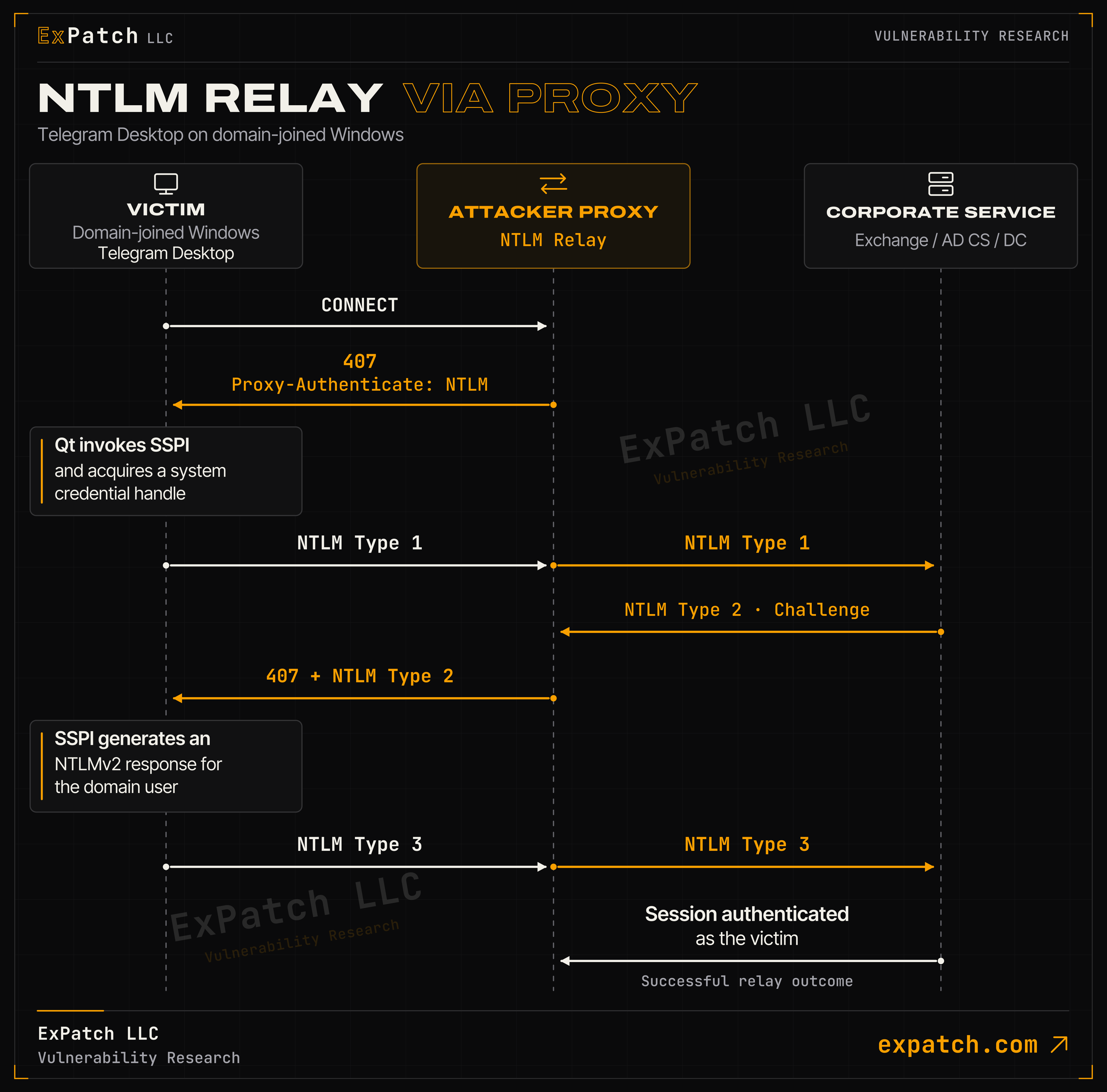
Two-Stage NTLM → Negotiate Escalation (P1): Two NTLMv2 Responses in One Session
Even supplying an explicit proxy username and password did not protect the user. A controlled server could force two consecutive authentications over a single connection:
1. 407 + Proxy-Authenticate: NTLM
   │
   └─► Qt uses the explicitly configured proxy credentials
       and produces NTLMv2 response no. 1

2. The proxy rejects the first authentication
   │
   └─► qhttpsocketengine resets the authenticator;
       user becomes empty

3. 407 + Proxy-Authenticate: Negotiate
   │
   └─► qSspiStartup() requests the default SSPI credentials;
       Negotiate falls back to NTLM;
       Qt produces NTLMv2 response no. 2
       for the Windows domain user
The attacker therefore received two different NTLMv2 responses in one session: the first based on the explicit proxy credentials, and the second based on the logged-on domain user’s account. Both were under attacker control, and the domain user’s response could be relayed immediately to a selected corporate service.
This scenario significantly expanded the affected population. The attack was not limited to clients with an empty username field: after rejecting the first authentication and forcing a second exchange through Negotiate, the proxy could reach system credentials even when the user had supplied separate proxy credentials.
SOCKS5-in-Tunnel Vector (V3): Injecting a 407 Into an Active Tunnel
Vector V3 did not require the victim to follow a tg://proxy link. It affected domain-joined Windows systems where an enterprise proxy was deployed centrally through GPO, WPAD, or a PAC file.
The key difference from the base vector was the injection point. After a SOCKS5 tunnel had been established, the controlled proxy could see Telegram Desktop’s unencrypted HTTP request—including its headers, URL, and MTProto POST body—and substitute the server response:
HTTP/1.1 407 Proxy Authentication Required
Proxy-Authenticate: NTLM
Qt interpreted the response as a normal proxy-authentication challenge and entered the SSPI path automatically.
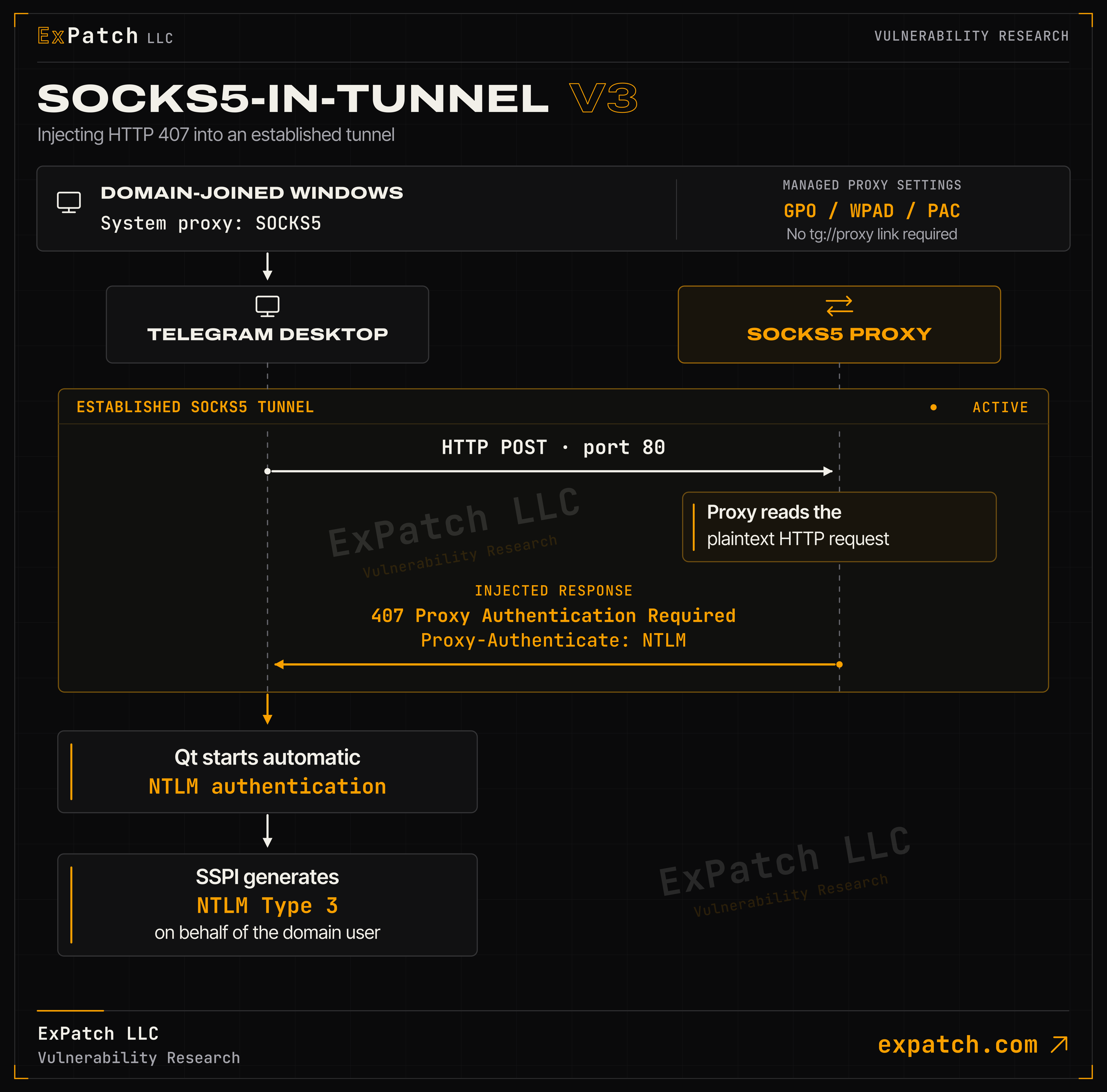
407 Proxy Authentication Required into an active tunnel, after which Qt automatically obtains an NTLMv2 response for the Windows domain user through SSPI.In a laboratory environment using a domain-joined Windows 10 machine, a single Telegram Desktop session produced more than 230 NTLM Type 3 messages. Qt’s repeated attempts multiplied the amount of authentication material available to the attacker and the number of relay opportunities.
The Root Cause Is in QtNetwork
Further analysis showed that Telegram Desktop was only one route into the vulnerable code. The root cause was located in QtNetwork’s shared HTTP authentication implementation, qauthenticator.cpp, and was not limited to 407 Proxy Authentication Required responses.
The same path could be reached without any proxy. If an attacker-controlled HTTP server answered an ordinary unencrypted request with 401 Unauthorized and the following header:
WWW-Authenticate: NTLMQt treated it as a routine authentication challenge. On a domain-joined Windows system with no explicit credentials supplied, the library called SSPI without user interaction and began an NTLM exchange on behalf of the current account.
The proxy was therefore not a prerequisite for exploitation, but an especially dangerous entry point in Telegram Desktop. The vulnerable mechanism lived deeper in the common Qt HTTP client stack used by many applications.
Where Else the Vulnerable Code Was Reachable
We did not stop at source review of Qt and Telegram Desktop. This was not a theoretical extrapolation from a shared API: we reproduced the same vulnerable primitive in qBittorrent, Nextcloud Desktop, and Electrum.
Other Applications Tested
- qBittorrent 4.6.3 with Qt 6.4.2. A controlled proxy switched the application from Basic to NTLM with a
407 Proxy Authentication Requiredresponse, without warning the user. The completed NTLM handshake produced a 65,076-byteNtChallengeResponse, approximately 64,876 bytes of which contained unrelated heap data. - Nextcloud Desktop 3.11.0 with Qt 5.15.13. One test session performed four consecutive NTLM exchanges. Each response reached 65,076 bytes, disclosing roughly 260 KB of memory in total. The dumps contained complete HTTP requests, Nextcloud WebDAV and API routes, service headers, and NTLM tokens from previous exchanges.
- Electrum 4.7.2 with Qt 6.11.0. We found a separate direct path that required no proxy. A controlled Bitcoin or LNURL invoice description was rendered as rich text by a QML component; an injected
<img src="http://…">causedQNetworkAccessManagerto request an attacker-controlled server. A401 WWW-Authenticate: NTLMresponse made Qt send an unsigned NTLM Type 1 automatically, while Electrum had noauthenticationRequiredhandler capable of stopping the exchange. We experimentally confirmed reachability and automatic NTLM initiation. Completing Type 3 through SSPI and relaying it requires a domain-joined Windows machine.
The same QtNetwork defect was therefore reproduced across independent products, Qt versions, and both 401 and 407 entry points. Telegram remained the principal object of the research, but the actual blast radius of the underlying root cause extended far beyond one application.
Second Primitive: Heap Memory Disclosure
Although the problem extended beyond Telegram, Telegram Desktop remained the primary target. We continued beyond forced NTLM authentication and relay. If an untrusted server could activate rarely used authentication code without user interaction and control the contents of NTLM Type 2, the remaining attacker-controlled fields also had to be audited.
That work exposed a second independent primitive: reading uninitialized heap memory in qExtractServerTime():
static QByteArray qExtractServerTime(const QByteArray &targetInfoBuff)
{
    QByteArray timeArray;
    QDataStream ds(targetInfoBuff);
    ds.setByteOrder(QDataStream::LittleEndian);
    quint16 avId, avLen;

    ds >> avId;
    ds >> avLen;
    while (avId != 0) {
        if (avId == AVTIMESTAMP) {
            timeArray.resize(avLen);                 // server-controlled length
            ds.readRawData(timeArray.data(), avLen); // short read is not checked        }
        // ...
    }
}
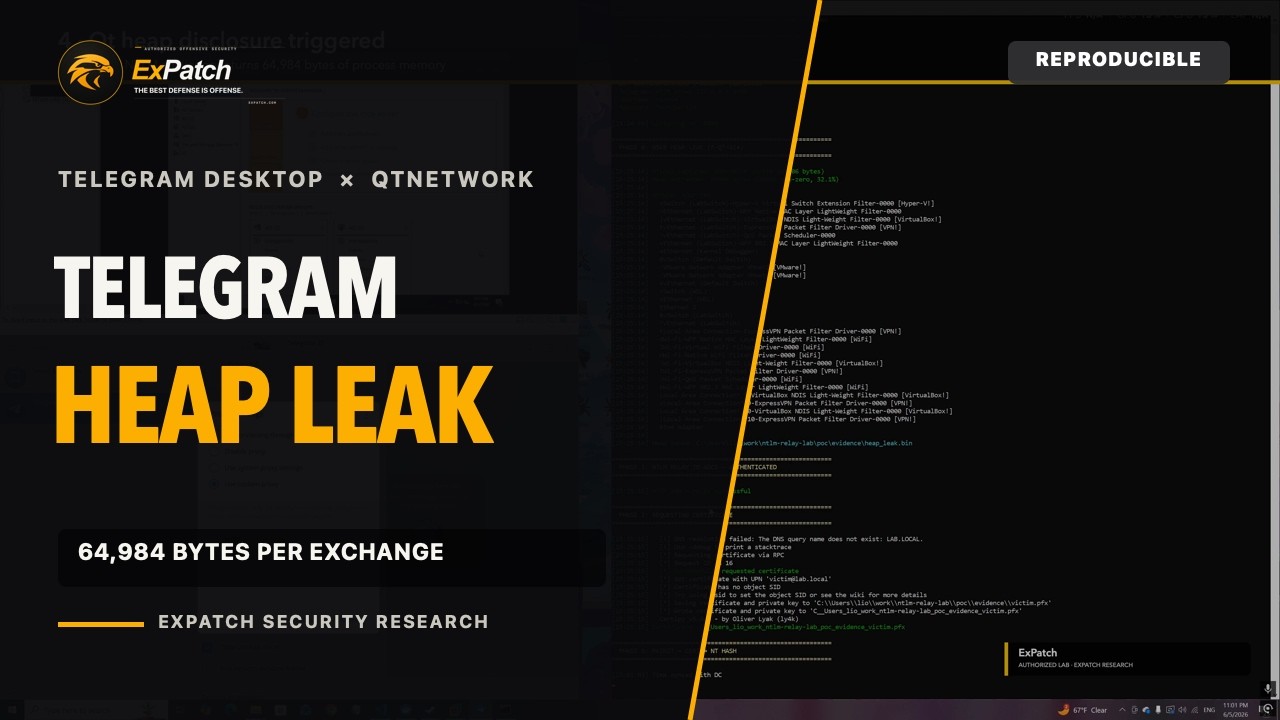
In NTLM Type 2, the server controls targetInfo, including the MsvAvTimestamp identifier and the 16-bit avLen field. We declared a length of 65,000 bytes but supplied only the eight-byte timestamp. Qt allocated the declared buffer, filled only the eight available bytes, and failed to check that readRawData() had performed a short read. The remaining 64,992 bytes retained prior heap contents. Qt then included the entire buffer—uninitialized area included—in the NTLMv2 response sent to the attacker’s server.
An ordinary NTLM exchange thus became a remote, repeatable memory-read primitive. In captured dumps, we confirmed disclosure of code pointers and heap metadata sufficient to bypass ASLR, network addresses, VPN client and adapter names, HTTP headers, and previous NTLM tokens. One hundred exchanges over approximately five minutes yielded about 6.5 MB of Telegram Desktop process memory.
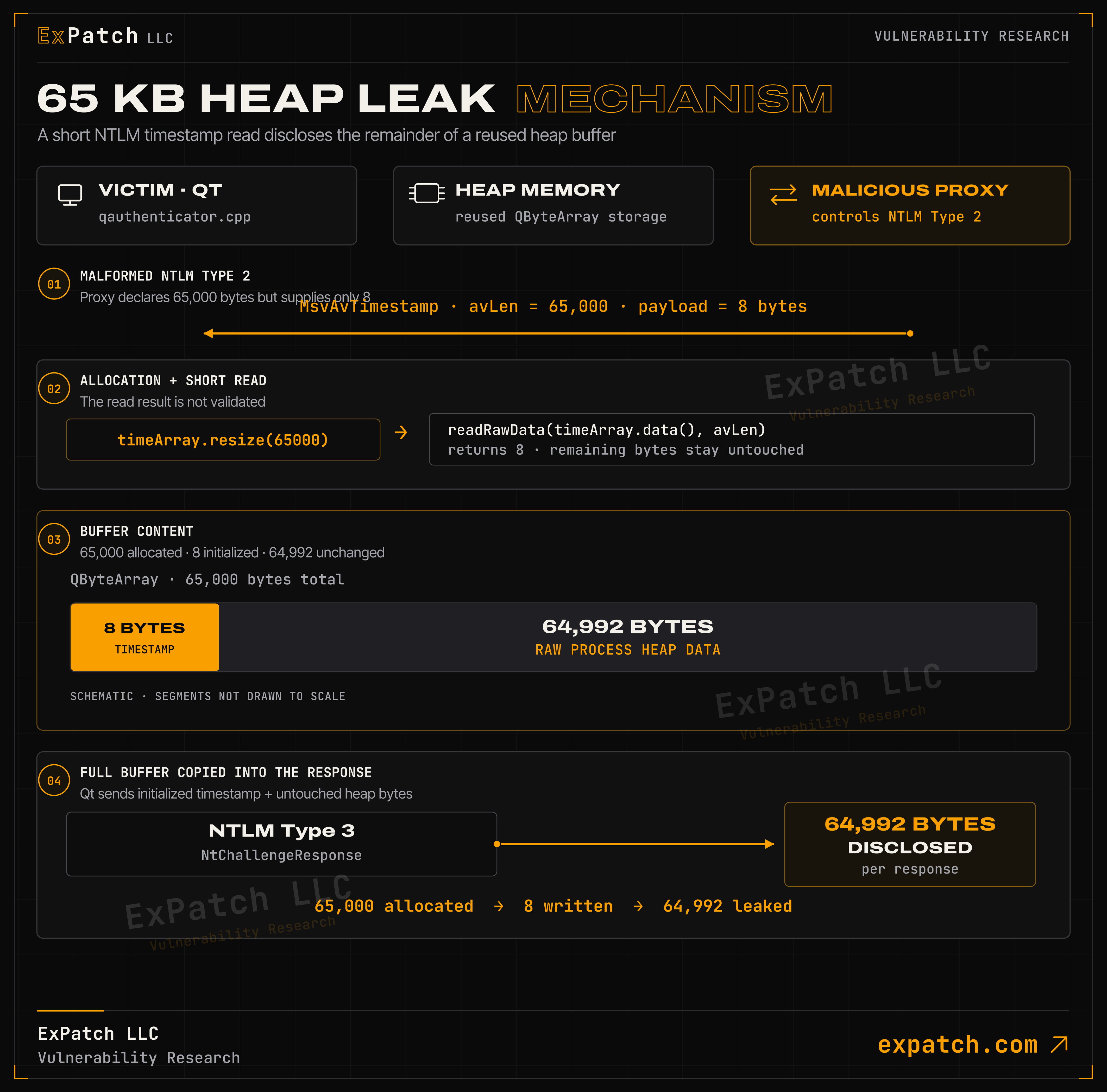
avLen, writes only the eight-byte timestamp, and includes the remaining 64,992 bytes of heap memory in NTLM Type 3.What the Leaked Memory Contained
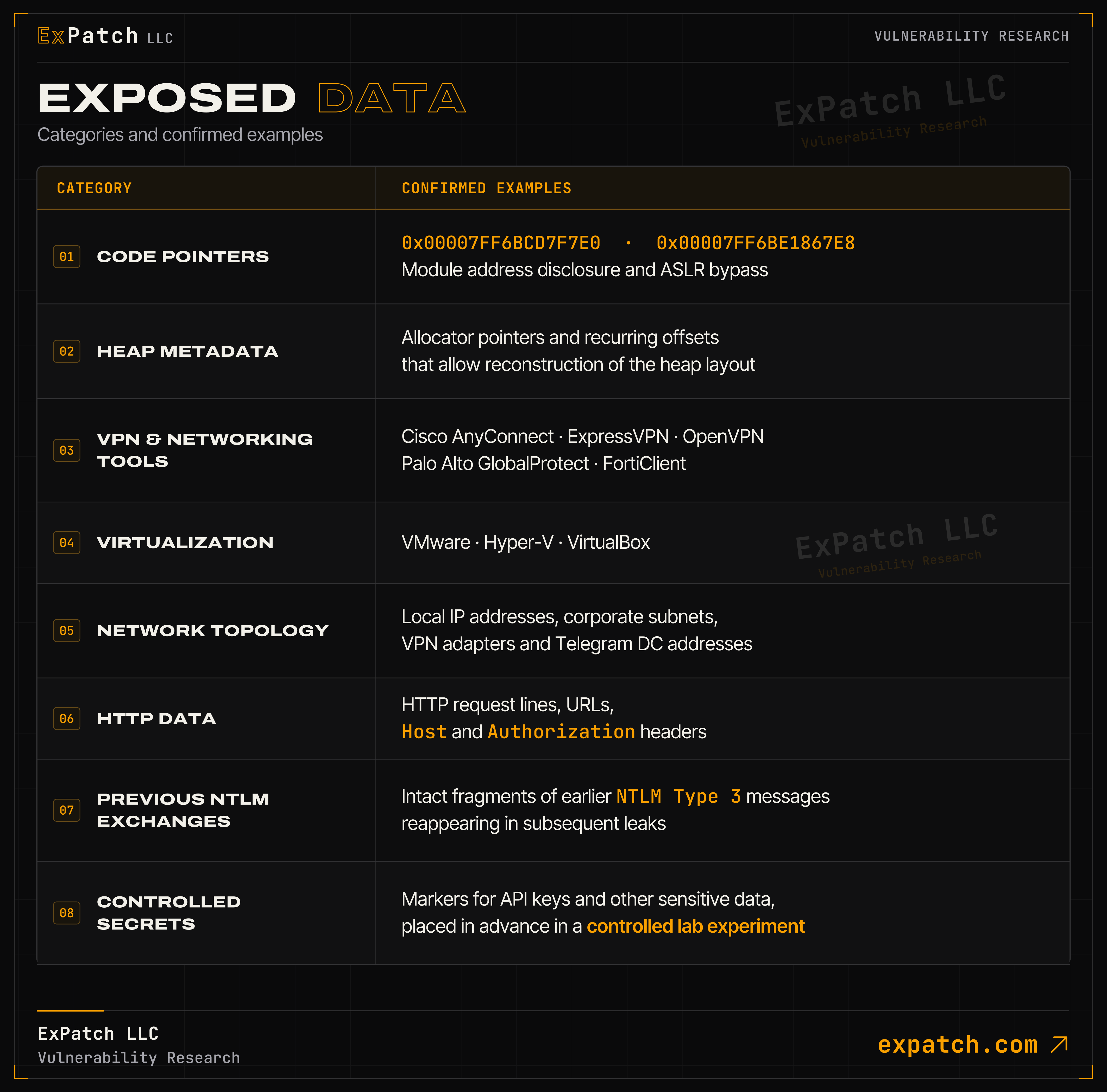
Individually, the fragments could look like random noise. Together, they formed a detailed profile of the device and its owner: username, work domain and hostname from NTLM, VPN software, virtualization, internal addressing, and enterprise network infrastructure.
The consequences were not limited to deanonymization. The vulnerability indiscriminately transmitted contents of reused heap buffers. Through controlled heap grooming, we placed test passwords and API-secret markers in those buffers and later recovered them from the NTLMv2 response sent to the proxy. The same mechanism could disclose API keys, session tokens, cookies, Authorization headers, and other secrets recently present in process memory. Later disclosures also contained previously generated NTLM Type 3 messages.
Importantly, the domain user’s password was not recovered directly from NTLM. Cleartext passwords could leak as contents of a reused buffer, independently of the NTLM protocol itself.
The most troubling aspect was the channel: a feature intended to help users bypass restrictions and retain access to information. The proxy continued to function, Telegram displayed no warning, and the user could not see that a malicious proxy operator was receiving process-memory fragments—including passwords, API secrets, and data capable of identifying the user or granting access to connected systems.
Video demonstration
Full RCE Chain: Laboratory Confirmation
To determine the maximum practical impact, we built an isolated Active Directory environment using Windows Server 2022 and an Enterprise CA with AD CS Web Enrollment enabled.
The victim ran the official Telegram Desktop 6.8.2 without any modification to its source, executable, Qt build, or authentication mechanisms. The client used its ordinary configuration. The user’s only action was to add a proxy through Telegram’s supported interface; every offensive component remained on the controlled proxy and laboratory infrastructure.
Once Telegram connected to the proxy, the chain executed automatically:
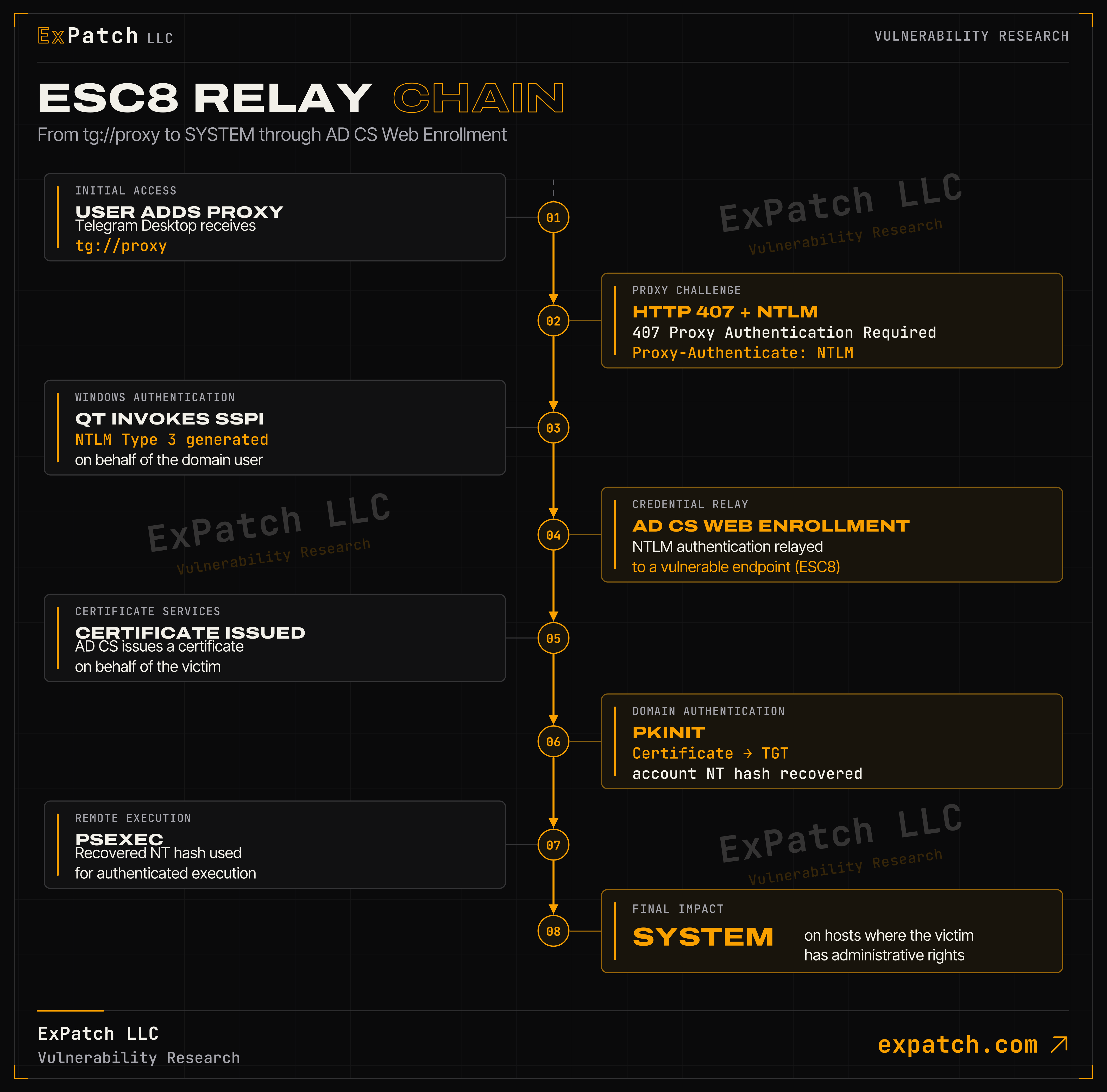
tg://proxy endpoint to obtaining SYSTEM on hosts where the compromised account held administrative privileges.Video demonstration
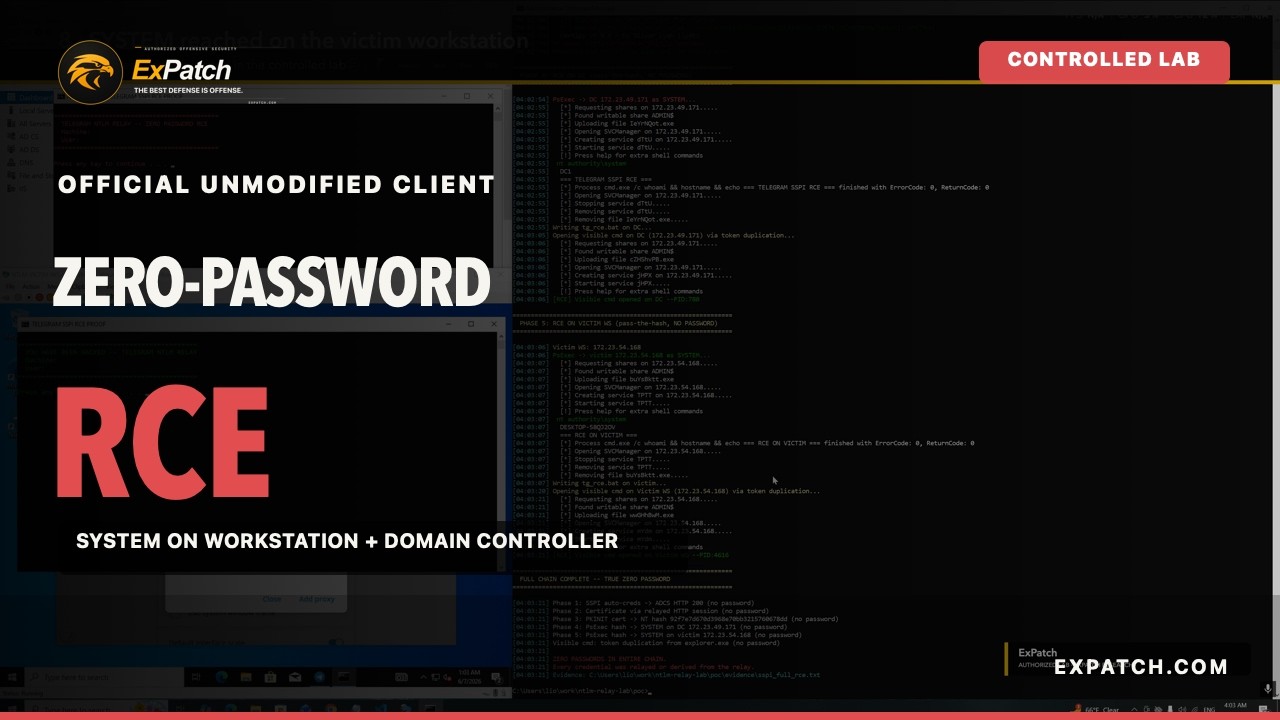
All nine AD CS relay attempts authenticated successfully and issued a certificate. Because the test account had Domain Admin privileges, we obtained NT AUTHORITY\SYSTEM on both the workstation and the domain controller. The complete chain took approximately 30–35 seconds and required neither password guessing nor password recovery.
Post-compromise access was determined by the victim account’s privileges: an ordinary user did not automatically become a domain administrator. Relaying an administrator, privileged employee, or service account, however, could lead directly to remote code execution and compromise of the corresponding systems. The experiment confirmed the worst-case impact demonstrated in our tests: complete domain takeover through an official, unmodified Telegram Desktop client after adding an attacker-controlled proxy.
The issued certificate also created persistence. A password change did not revoke it automatically; with a one- or two-year certificate lifetime, an attacker could continue authenticating until expiration, explicit revocation, or account disablement.
Why This Was a Telegram Desktop Vulnerability, Not Only a Qt Vulnerability
Reducing the issue to the source file containing the defect ignores the exploitation chain. The library root cause was indeed in QtNetwork. But the attack did not begin inside an abstract Qt application: it began in the official Telegram Desktop client after a proxy was added through the supported tg://proxy mechanism.
Telegram Desktop made the defect practically reachable by:
- accepting and persisting a user-supplied proxy;
- passing it to Qt without prohibiting NTLM and Negotiate;
- giving the user no opportunity to see or reject the proxy-selected scheme;
- allowing an untrusted proxy to activate SSPI and obtain an NTLMv2 response;
- transmitting Telegram Desktop process-memory fragments through the same channel.
This was more than the passive presence of a vulnerable dependency. Remove any key product element—tg://proxy, automatic proxy persistence, or the absence of an NTLM prohibition—and the Telegram path no longer works. Telegram’s product decisions were therefore a necessary part of exploitation, not incidental surroundings for a library flaw.
Responsible Disclosure and Timeline
June 6: Telegram Receives the Complete Report
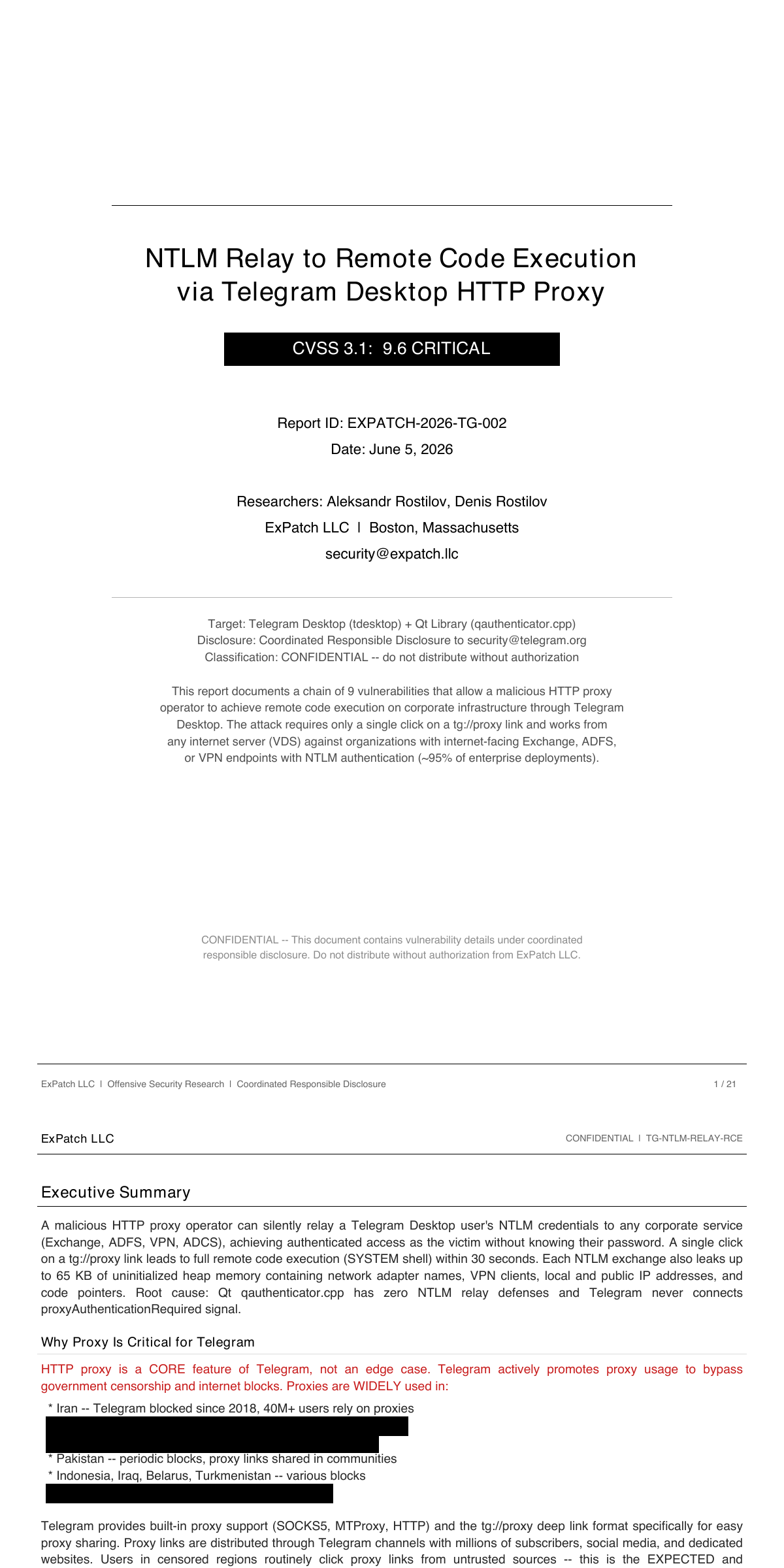
After a night of continuous validation and preparation, on June 6, 2026, we sent Telegram not a short description or preliminary hypothesis, but a finished 21-page technical report: EXPATCH-2026-TG-002. The package included source-code analysis, exploitation conditions, a PoC, a video demonstration, laboratory results, and the complete RCE chain.
A dedicated section already documented the memory disclosure in qExtractServerTime(): the server-controlled MsvAvTimestamp.avLen field, expansion through timeArray.resize(avLen), the unchecked short read in readRawData(), and transmission of the unread heap contents inside the NTLMv2 response. On page 20, we proposed a specific remediation: validate avLen against the remaining buffer and accept a timestamp only at its expected length of eight bytes.
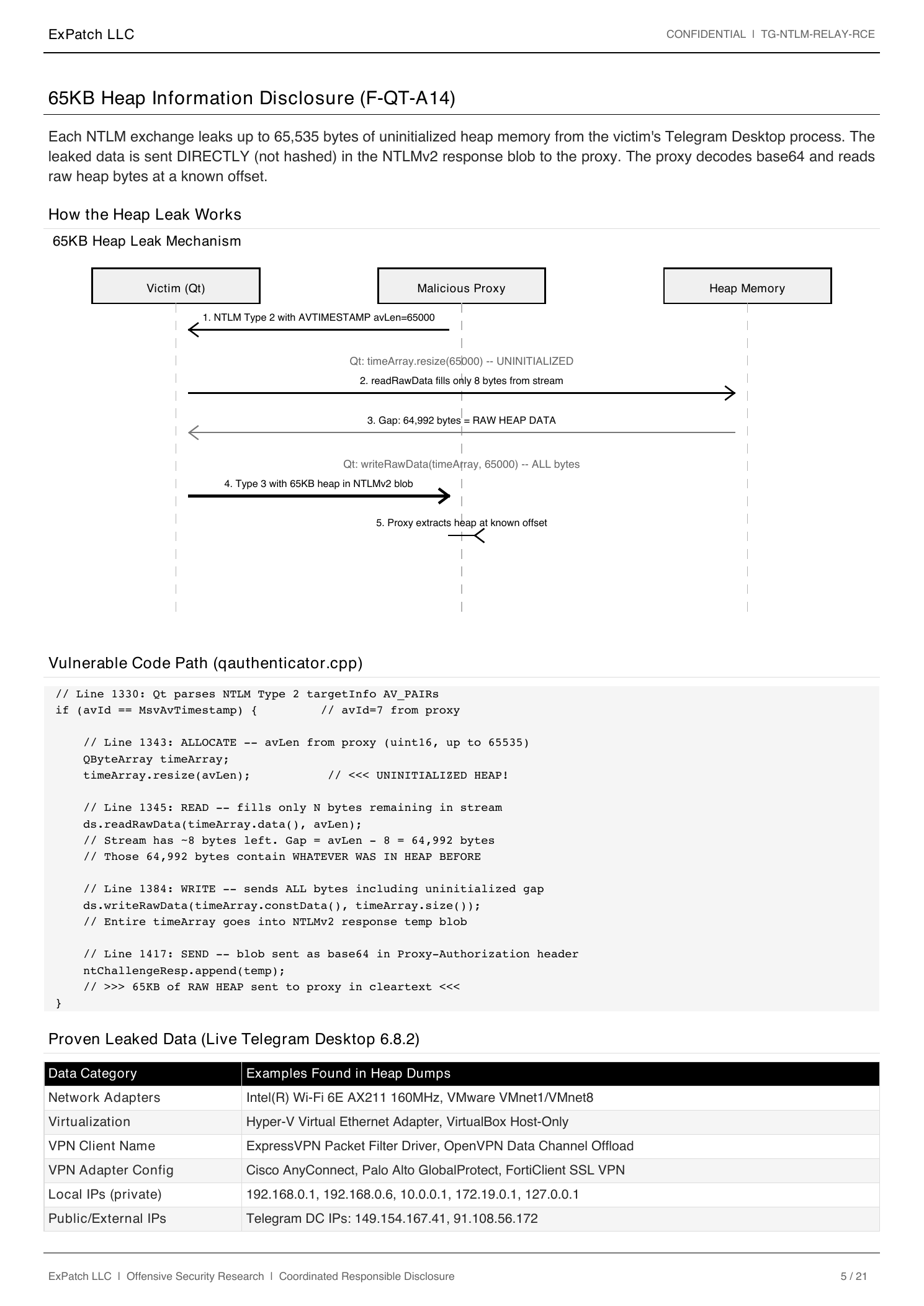
avLen, disclosure of 64,992 heap bytes, and results reproduced against the standard Telegram Desktop 6.8.2 client.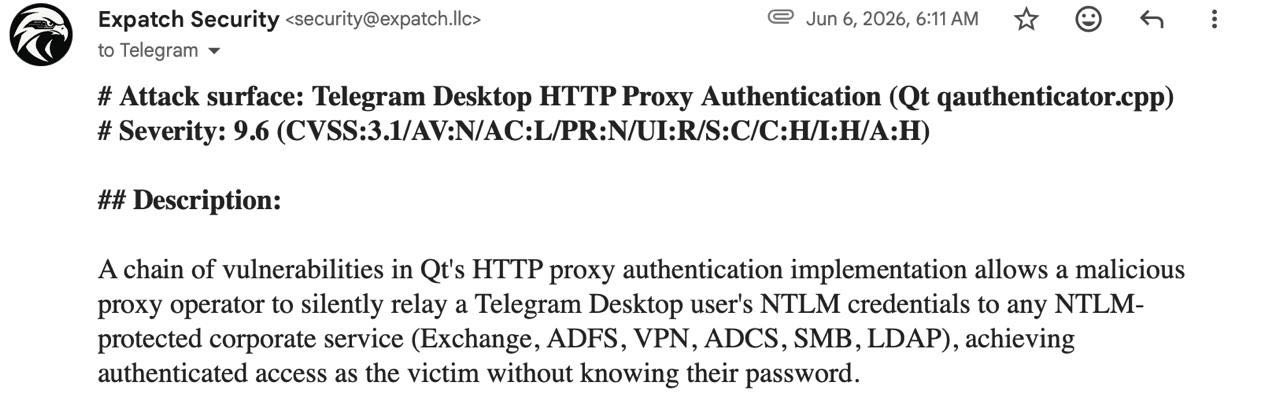
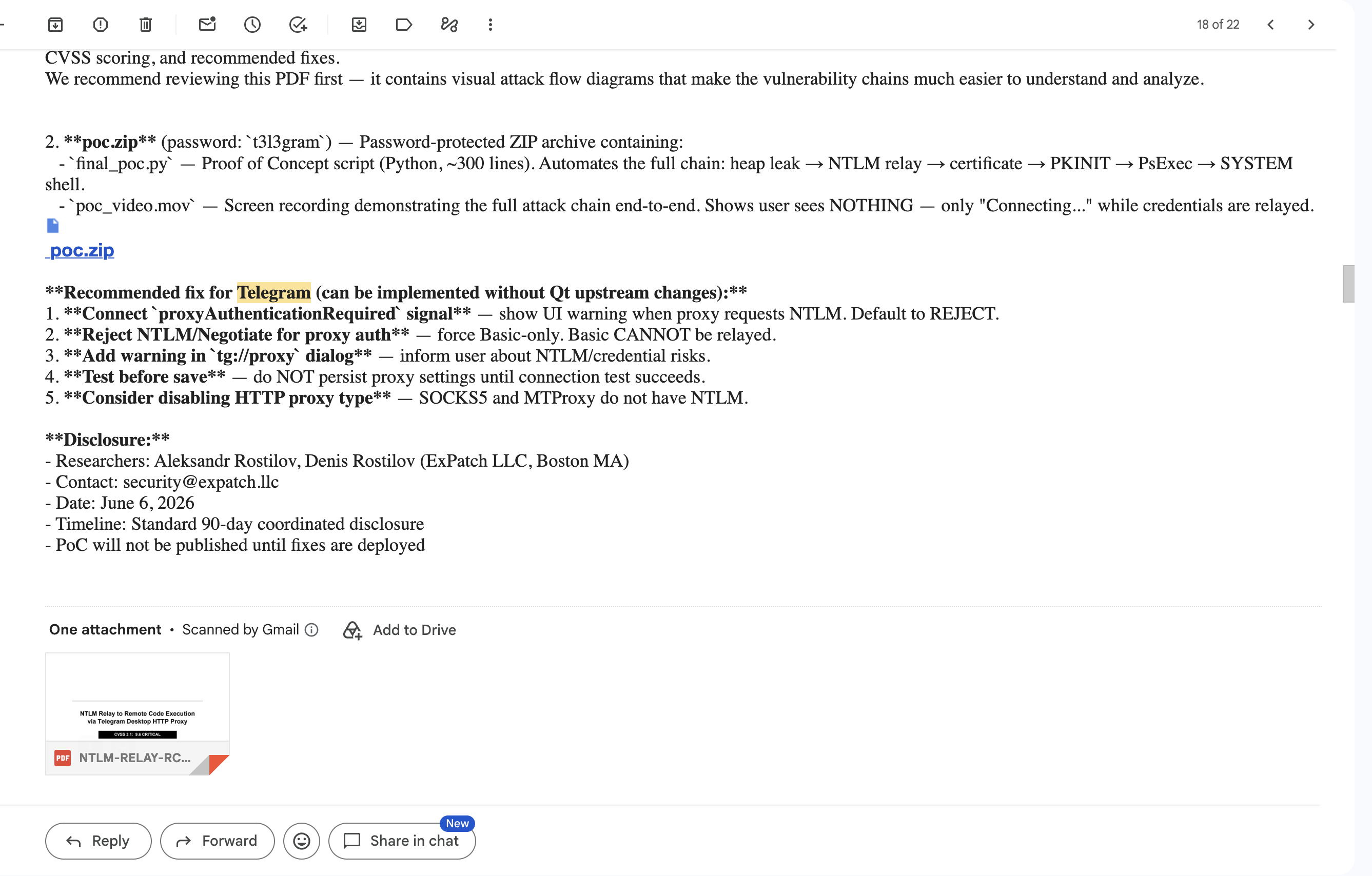
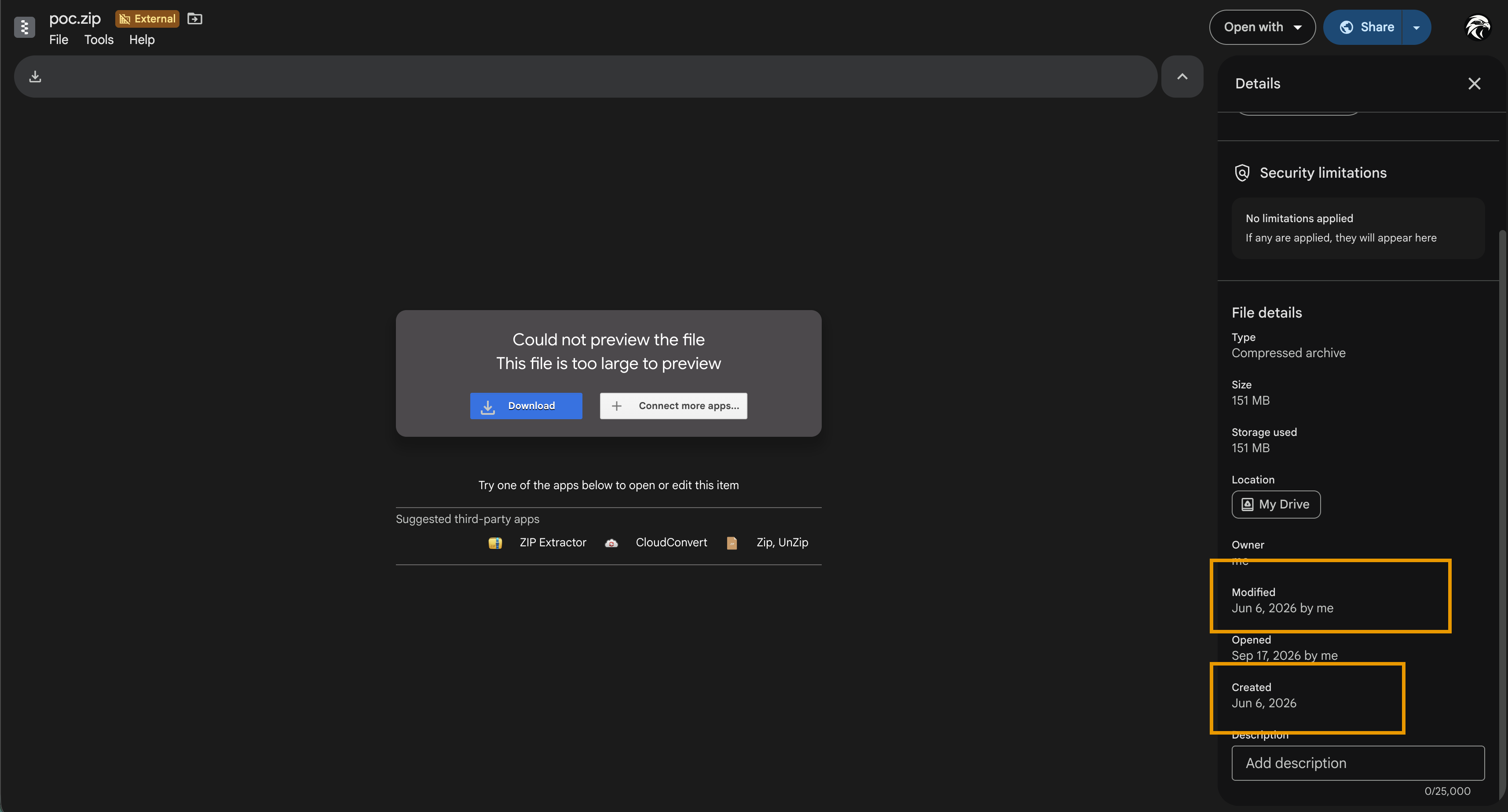
poc.zip archive to June 6, 2026.The image alone does not prove that the recipient downloaded the archive. Together with the email containing the poc.zip link, however, it establishes that the complete PoC existed and was available to Telegram on the day of disclosure.
The timeline is also supported by the original PDF metadata. Its cover is dated June 5, while CreationDate records June 6, 2026 at 04:04:01 UTC—approximately six hours before the email shown above. The file’s SHA-256 is:
SHA-256
c2c88a4db92a9fb06cd64a2efec3e337714a0ecdc32526c6a65b4dc477173f6cThe cover prominently marked the document CONFIDENTIAL and stated that it was supplied under Coordinated Responsible Disclosure, with redistribution prohibited without permission from ExPatch LLC. We approached Telegram before completing a separate disclosure to Qt because Telegram could immediately block the most dangerous path inside its own application.
June 7: Telegram Receives a Fully Working Exploit
The original report was not the end of the disclosure. On June 7, we sent Telegram an additional email with an improved sspi_rce_v3.py: a 694-line end-to-end exploit requiring no password, accompanied by a video of the complete attack. This was neither a conceptual demonstration nor a loose collection of techniques; all necessary credentials were relayed automatically or extracted from the resulting relay chain.
The email described consequences for an ordinary domain user: client-certificate issuance through AD CS, access to Exchange OWA and ADFS, movement to machines where the victim had local administrative rights, and privilege escalation where certificate templates were insecure. In the Domain Admin scenario, the demonstration ended with NT AUTHORITY\SYSTEM on both a workstation and the domain controller, from which complete domain compromise was possible.
The video showed the controlled proxy output, NTLM relay, certificate issuance, PKINIT authentication, and a command prompt appearing on the victim desktop. Telegram received not merely a description of potential harm, but a complete implementation reproducing the chain against a standard, unmodified Telegram Desktop client in an isolated environment.
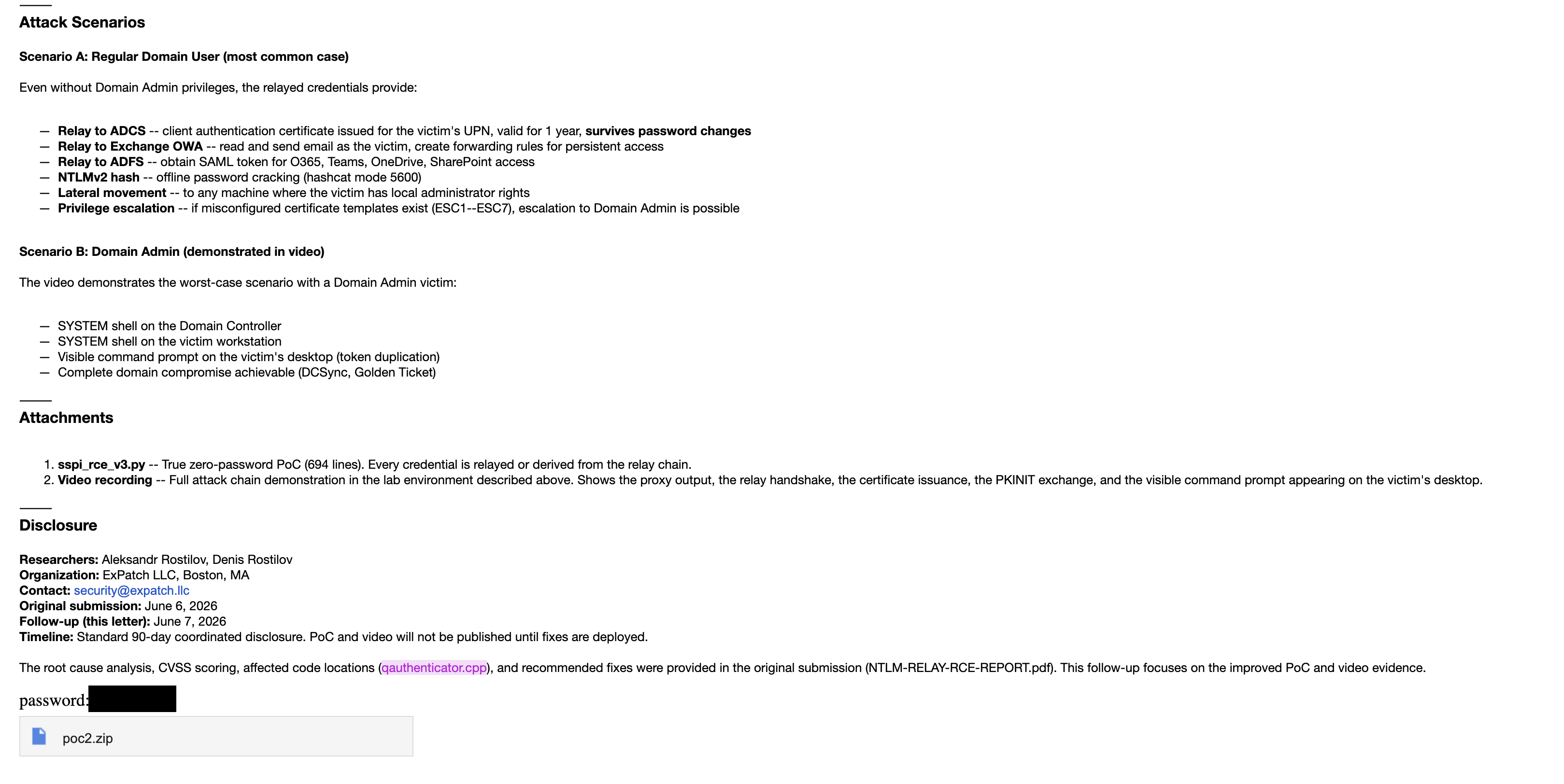
sspi_rce_v3.py, a video of the complete chain, and the attached poc2.zip. The email also records ExPatch’s commitment not to release the PoC or video before fixes were available.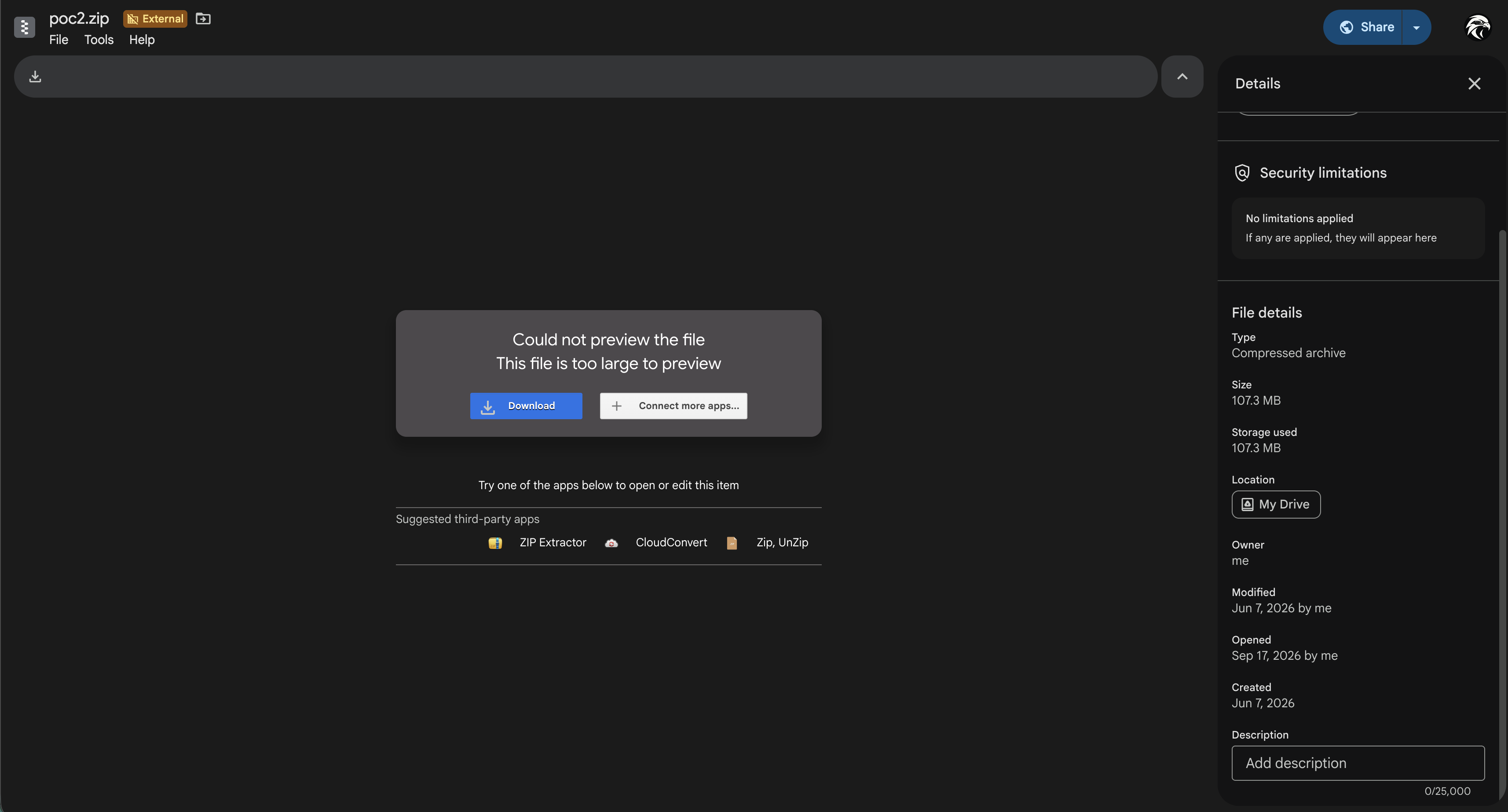
poc2.zip on June 7, 2026.June 8: Investigation Acknowledged and Two Precise Patches Appear
At 05:08 on June 8, Telegram Support acknowledged receipt and wrote:
“The team is investigating your research, and we will contact you soon.”
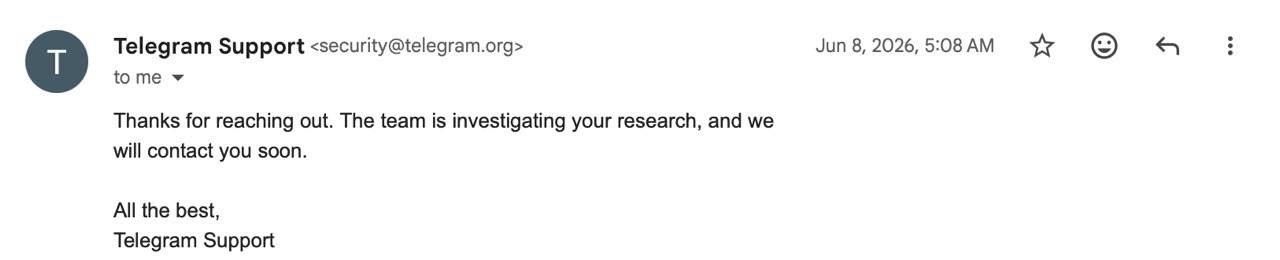
The public history of the dependency repository used by Telegram Desktop dates two new commits to the same day:
- at 13:23:04 UTC, a Qt 5 patch;
- at 13:27:01 UTC, a Qt 6 patch.
Both commits identify John Preston as the author. In New York time, they were recorded at 09:23 and 09:27—approximately four hours after Telegram’s reply.
Their content matters as much as their timing. The Qt 6 patch introduced a new file, qtbase_6.11.1/0038-disable-proxy-ntlm.patch, and addressed both independent issues described in our report: forced NTLM/Negotiate authentication through a proxy and the memory disclosure in qExtractServerTime().
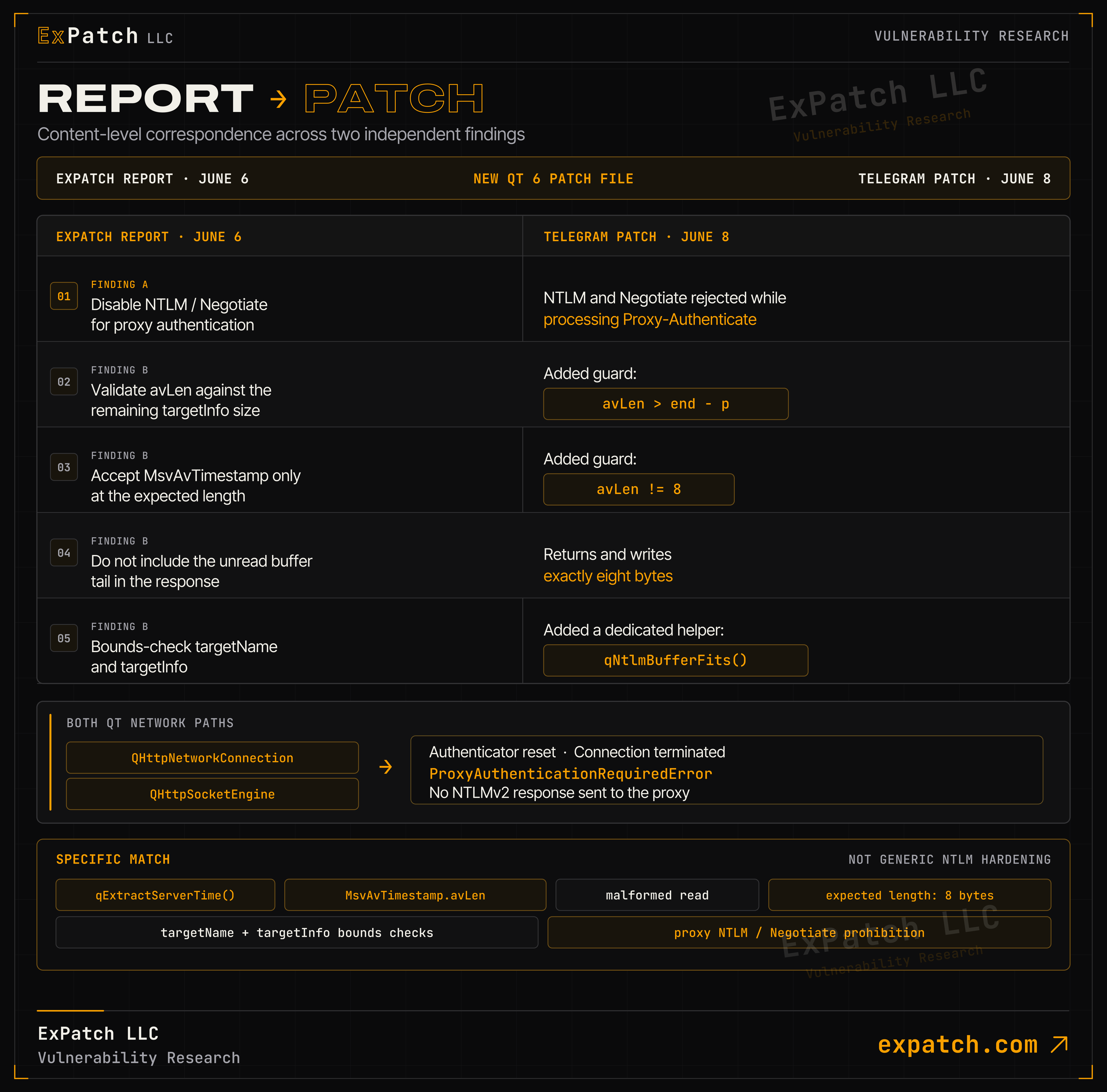
MsvAvTimestamp.avLen handling.The change was not generic “NTLM hardening.” It added an avLen > end - p remaining-buffer check, required avLen == 8, returned and wrote exactly eight timestamp bytes, and introduced qNtlmBufferFits() for targetName and targetInfo bounds checks. These are the same fields, conditions, and safeguards identified in the report.
The patch also covered both Qt network paths used by Telegram: QHttpNetworkConnection and QHttpSocketEngine. When NTLM or Negotiate was detected, the authenticator was reset, the connection ended with ProxyAuthenticationRequiredError, and no NTLMv2 response was sent to the proxy.
June 15–16: Bounty Offer, NDA, and Confirmation of the Fixes
On June 15, Telegram thanked us for the report and offered a $1,000 bounty:
“We would like to award you a bounty of $1000 for your findings regarding NTLM via proxy settings.”
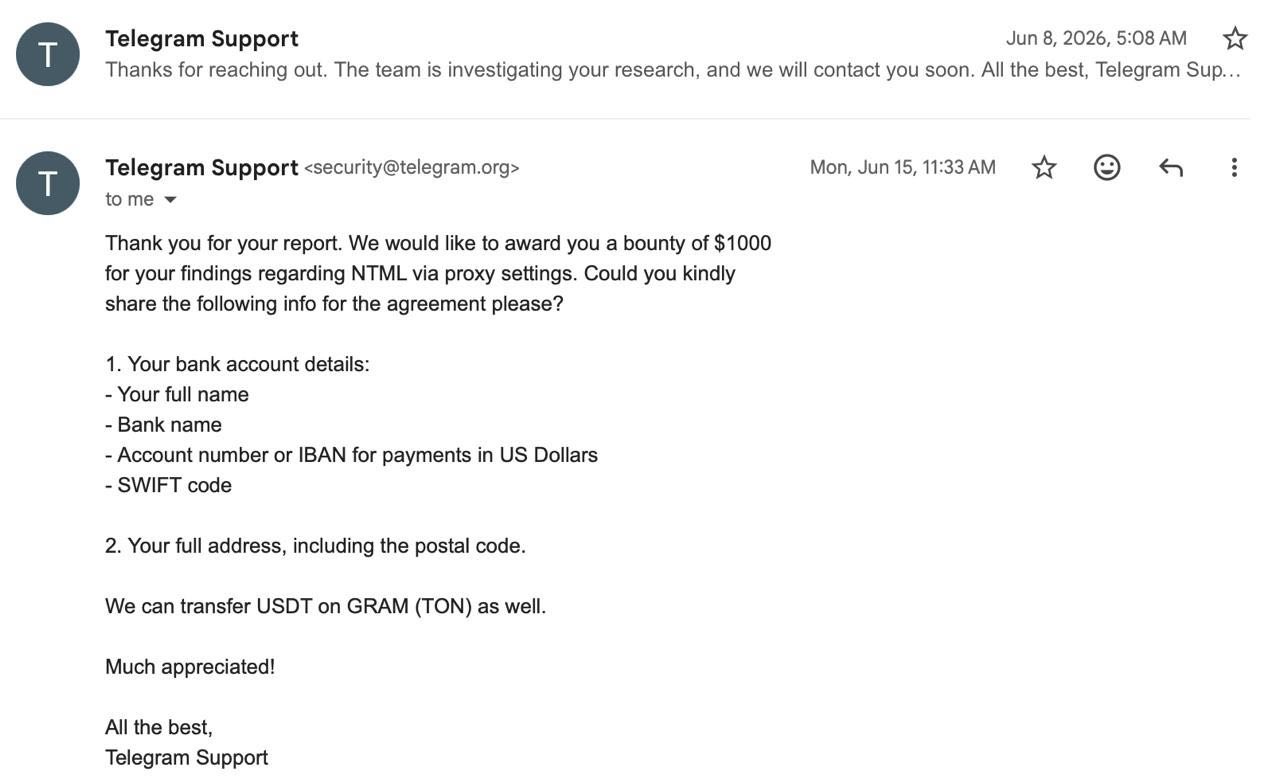
By then, Telegram’s patch contained two independent measures: prohibiting NTLM/Negotiate for proxies and fixing the qExtractServerTime() memory disclosure. The wording of the message did not establish whether the decision covered the complete set of scenarios or only the proxy-related portion of the research.
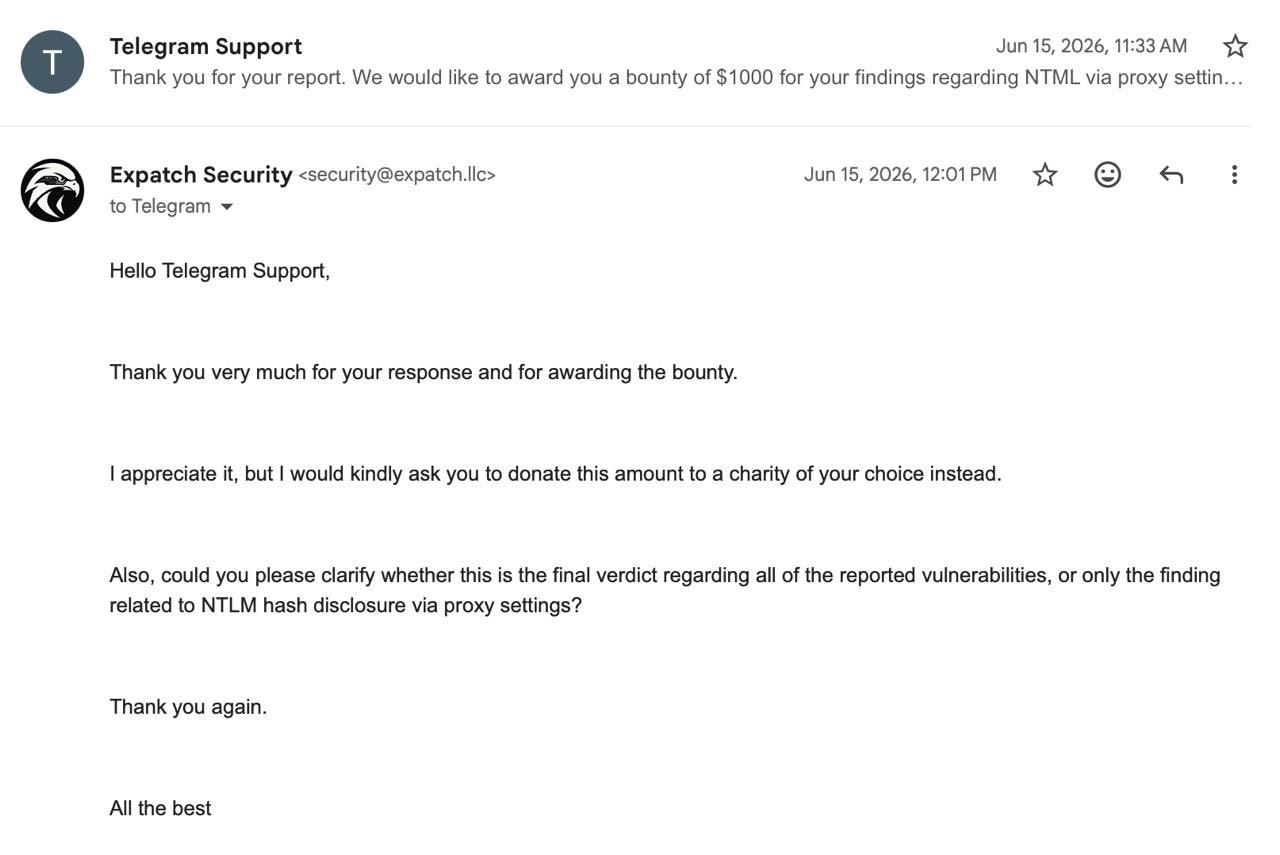
Money was not our primary concern. We asked Telegram to donate the offered amount to a charity of its choice and requested clarification on whether the decision was final for every reported vulnerability or only for NTLM disclosure through proxy settings.
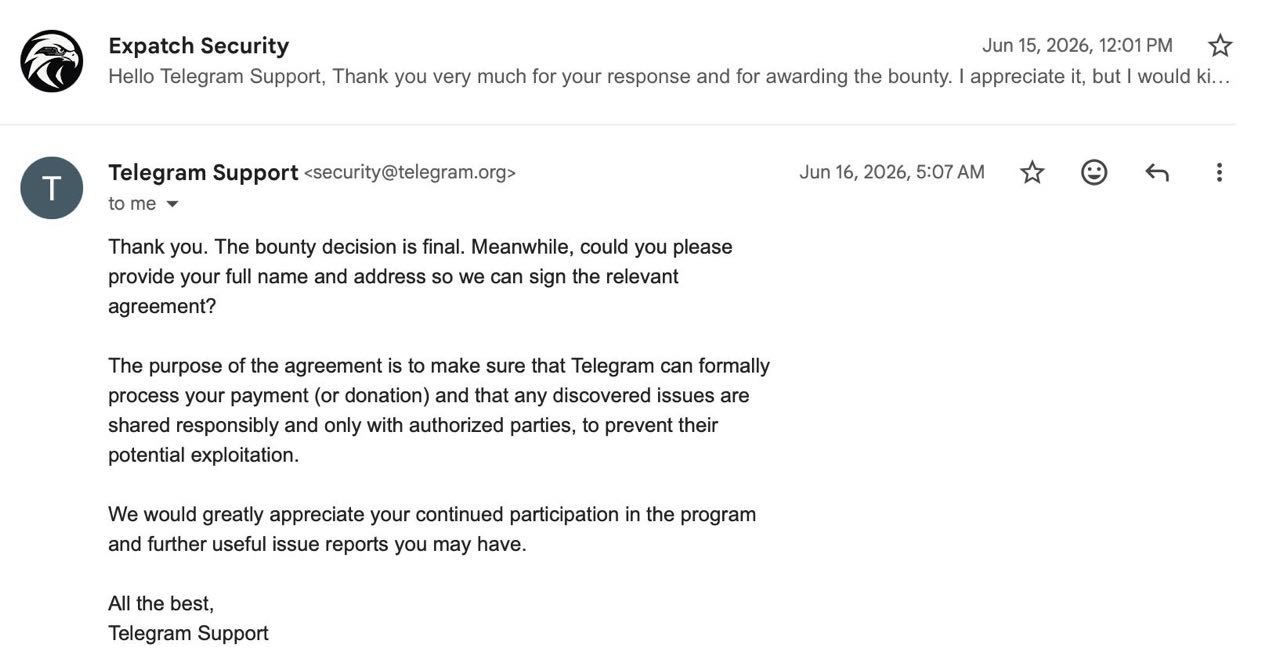
At 05:07 on June 16, Telegram said the bounty decision was final and directly proposed an agreement that effectively functioned as an NDA. According to the message, its purpose was not only to process the payment or donation, but also to ensure that details of discovered issues were shared “responsibly and only with authorized parties.”
At 05:56, we declined to sign the agreement and recorded our responsible-disclosure position: the technical report would be published after remediation or upon expiration of 90 days from the initial disclosure. We also asked Telegram to notify us once the issues had been fixed or otherwise mitigated.
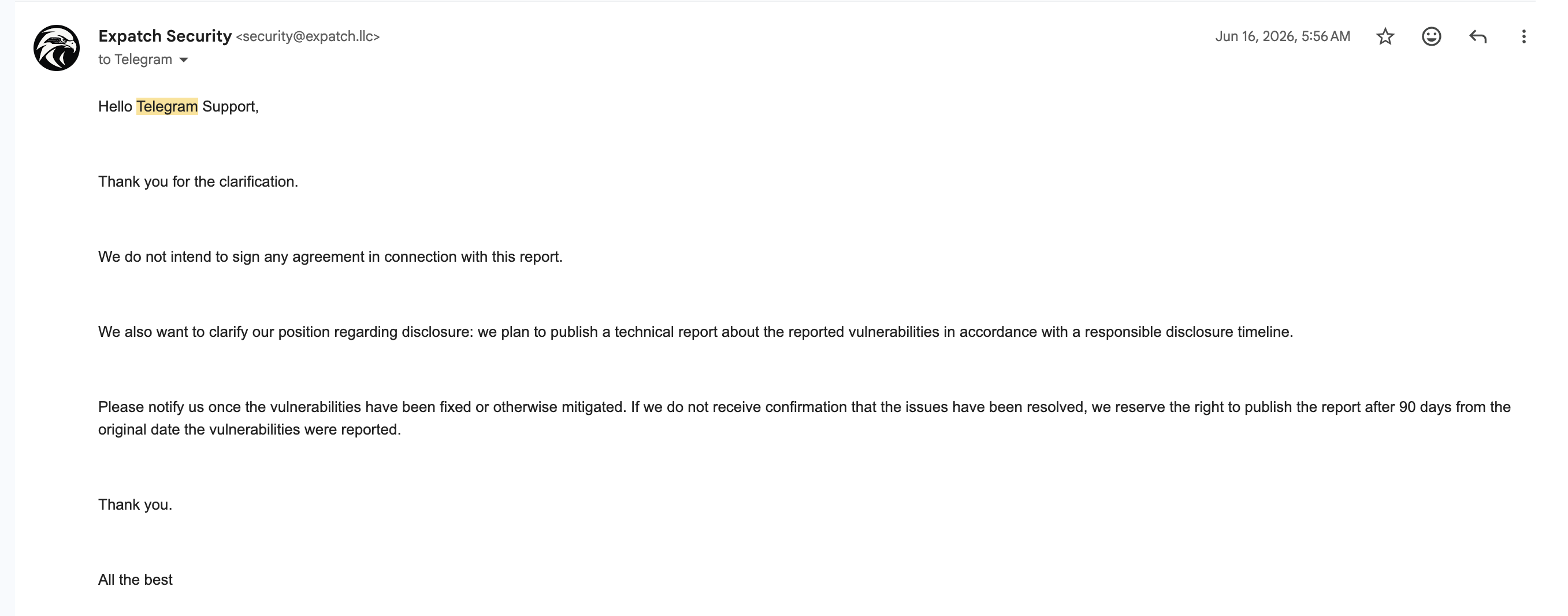
At 08:53, Telegram sent a separate technical clarification:
“Telegram Desktop v6.9.2 contains fixes for all reported scenarios, with one exception.”
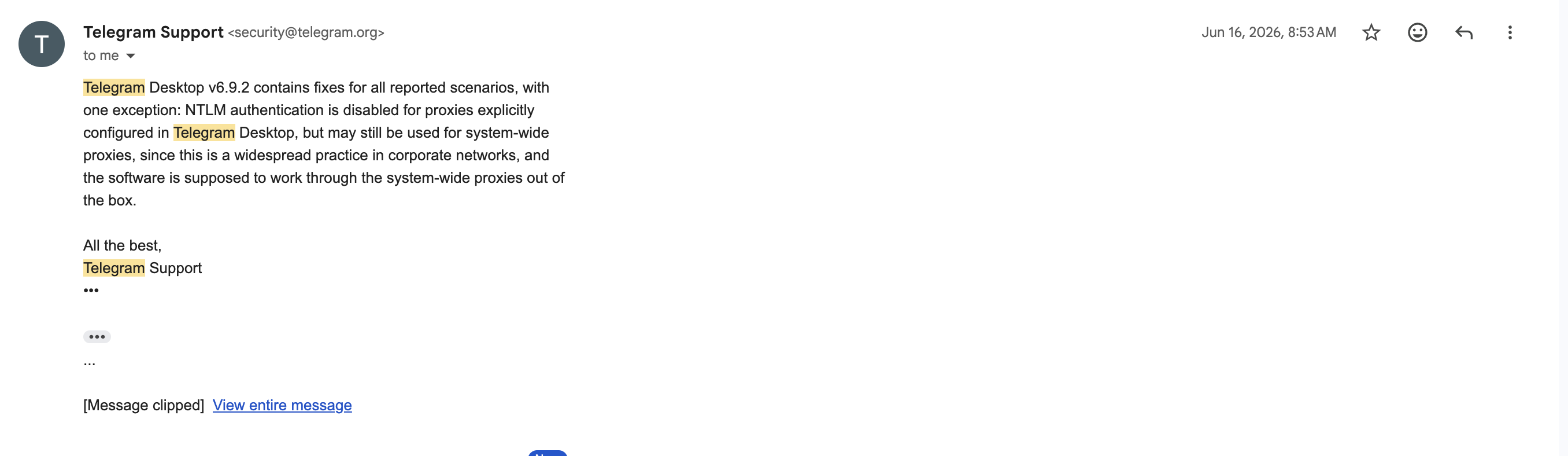
According to Telegram, NTLM was disabled for proxies explicitly configured inside Telegram Desktop, but remained available to system-wide proxies because those configurations are widely used in corporate networks. This exception exactly matched the distinction introduced while the patch was revised on June 10–11: proxies from tg://proxy and application settings were blocked, while system proxies were allowed to use NTLM.
After receiving this response, we decided to complete our separate disclosure to Qt and downloaded the current Qt 6.11.2 branch to check whether the issues were still reproducible. In that branch, however, the vulnerable paths had already been closed.
Reviewing Qt’s history after Telegram’s June 16 response, we discovered matching upstream fixes. Telegram had told us neither that the materials were being transferred nor that coordination with Qt was taking place. ExPatch and the researchers were excluded from the public record of the fixes.
What Matters Is Not the Number of Matches, but Their Precision
We do not claim every subsequent NTLM change in Qt. Our case does not require a long list of tasks and does not rest on broad thematic similarity. It is based on a documented sequence and correspondence traceable to specific lines of code.
On June 6, Telegram received our confidential report describing the qExtractServerTime() defect: the server-controlled MsvAvTimestamp.avLen field, expansion through timeArray.resize(avLen), the incomplete input read, and the subsequent inclusion of uninitialized heap memory in the NTLMv2 response. The report also proposed validating avLen against the remaining buffer and accepting only the expected eight-byte timestamp.
On June 8, Telegram’s repository history records a patch implementing those checks. It added avLen > end - p and avLen != 8, returned only the eight timestamp bytes, and limited the subsequent write to those same eight bytes. The patch simultaneously closed the second reported path by prohibiting NTLM/Negotiate for proxies configured explicitly inside Telegram Desktop.
On June 10, Qt opened QTBUG-147373, recording the start of upstream NTLM work two days after Telegram’s acknowledgement. The associated commit was 6e88e0f708. Two days later, on June 12, Gerrit 744448 appeared: the same qExtractServerTime() function, the same MsvAvTimestamp.avLen field, an eight-byte timestamp requirement, and boundary-condition tests.
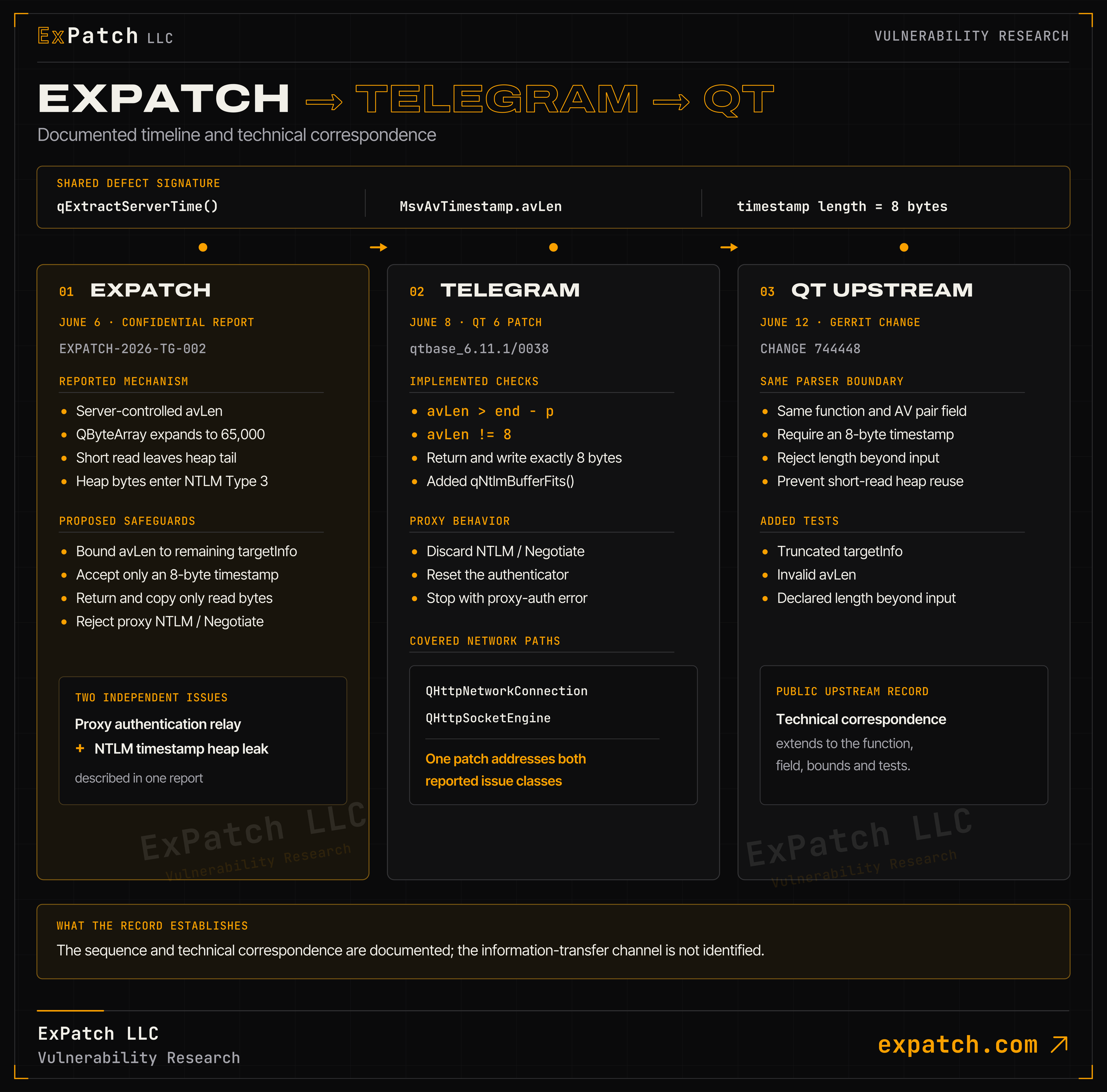
Telegram’s patches addressed both problems described in our report: they prohibited NTLM/Negotiate for proxies added within the application and fixed the heap-memory disclosure. Qt subsequently fixed the same timestamp-handling flaw, checking the bounds of the input buffer and requiring an eight-byte timestamp. The match is traceable to the specific defect, the safeguards we proposed, and the behavior of the corrected code.
These changes addressed the problems at two levels. Telegram restricted the dangerous behavior within its own product; the Qt fix addressed the data-handling flaw in the shared library. That is why information about the upstream work mattered to us: we were preparing a separate disclosure to the Qt developers, only to discover that the corresponding changes had already been made. Users received protection, but the researchers were not included in the coordination behind it.
Neither Telegram nor Qt publicly explained the origin of the technical match between the report and the patches or credited us in the records we reviewed. The question is no longer whether a match exists, but how the results of our confidential research reached the upstream fix without notification or attribution.
This Is Not a Dispute Over One Thousand Dollars
For a small research team, public attribution is not a formality or a matter of ego. It is the professional result of forty days of work, evidence of competence, and the foundation of trust on which coordinated disclosure depends. A researcher gives a vendor unpublished material first, granting time and a technical advantage to protect users. In return, the researcher is entitled to expect transparent coordination and credit for their work.
Telegram used that head start to prepare fixes, and users benefited. But when the corresponding Qt changes appeared, we were not informed of the coordination, and neither ExPatch nor the researchers appeared in the public records we reviewed. The company received every benefit of responsible disclosure; the researchers did not receive even the basic transparency on which the model relies.
We are not asking readers to take our word for it. We are publishing the original report, its SHA-256 and metadata, correspondence, laboratory results, vulnerable code, patches, and an exact timeline. We expect Telegram and Qt to answer in the same language—the language of facts: how the results of our confidential research came to be reflected in the upstream fix, and why their source remained unattributed.
Thank you for your time and attention. Research does not live where it is published, but where it is read, verified, and discussed. That is how an individual finding becomes a contribution to the security of every user.
Sincerely,
Alexander Rostilov and Denis Rostilov
ExPatch Vulnerability Research Team
Research and demonstrations: Alexander Rostilov and Denis Rostilov, ExPatch Vulnerability Research Team.
Full report (PDF): English · Русский
Video and illustrations: ExPatch LLC.
Contact: security@expatch.llc · expatch.com